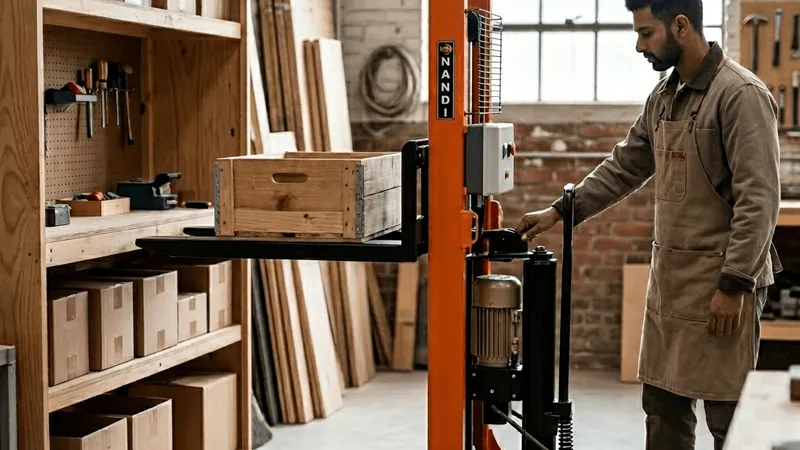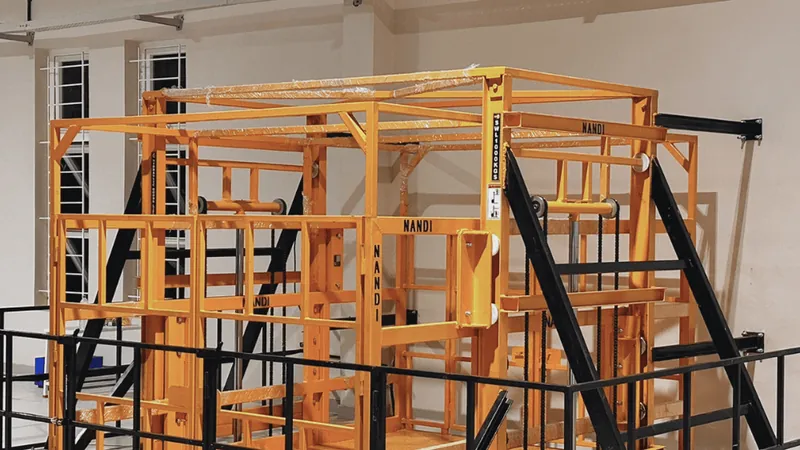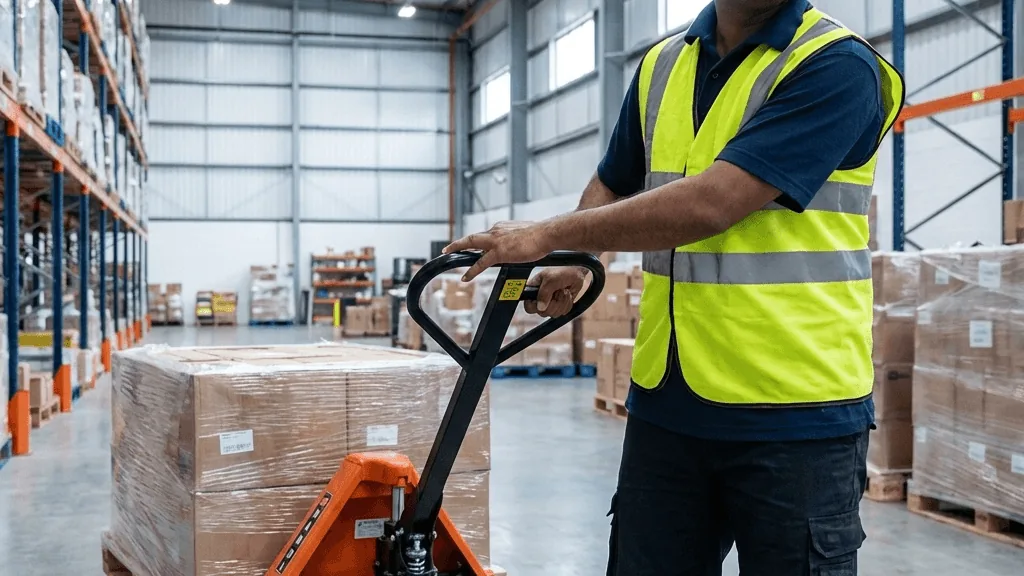
A 2,000 kg stacker is a 2,000 kg stacker only at one load centre, one fork height, on one kind of floor, at one temperature. Move any of those and the usable figure moves with it. Here is how Nandi pallet trucks, stackers and lift tables behave once they leave the test bay, and how to write an enquiry that gets you comparable, honest quotations.
What the plate is actually certifying
The capacity stamped on a pallet truck or stacker is a type-test figure. It assumes a load at the standard load centre, a level and sound floor, forks near their lowest position, an ambient inside the design band, and a machine in as-new condition. Those assumptions hold in a test bay. Few of them survive a spinning mill in May, a tiled godown in Tiruppur, or a loading ramp at a Hosur auto-component plant.
The plate is not wrong. It is a single point on several curves, and the buyer’s job is to find where the application sits on them before the purchase order goes out.
Load centre: the number nobody writes down
Load centre is the horizontal distance from the fork face to the load’s centre of gravity. Indian stackers are normally rated at 500 mm or 600 mm, because a well-loaded 1,200 × 1,000 mm pallet entered on its 1,000 mm side puts its mass roughly there.
Move the centre of gravity outward and the overturning moment rises in proportion, while the machine’s resisting moment (wheelbase and self-weight) stays fixed. A stacker rated 2,000 kg at 500 mm is, in round terms, a 1,650 kg machine at 600 mm and a 1,400 kg machine at 700 mm. Enter a 1,200 mm pallet from the long side, or stand a paper reel against the mast with another in front of it, and you have moved the load centre without changing anything on the weighbridge.
Lift height derates it again
On any stacker there is a second curve: residual capacity against lift height. Mast deflection, chain stretch and a raised centre of gravity all reduce what the machine safely holds as the forks go up. A single-mast hydraulic manual stacker lifting to 2,000 mm, or a double-mast telescopic AC stacker lifting to 4,000 mm, does not carry its plate rating to the top. The table below is illustrative of the shape of that curve; the actual figures for a given Nandi model come from the capacity chart supplied with the quotation.
| Fork height | 500 mm load centre | 600 mm load centre | Typical situation |
|---|---|---|---|
| Up to 800 mm | 2,000 kg | ~1,650 kg | Truck-bed height, work-table loading |
| 1,200 mm | ~1,800 kg | ~1,500 kg | First rack beam in most godowns |
| 1,600 mm | ~1,600 kg | ~1,300 kg | Second beam level, single mast |
| 2,000 mm | ~1,400 kg | ~1,150 kg | Single-mast maximum |
| 3,000 mm and above | ~1,000 kg | ~800 kg | Double-mast telescopic only |
The consequence: a plant placing a 1,500 kg pallet of dyed yarn on a beam at 2,000 mm should be reading the 2,000 kg column of the catalogue. The smaller unit lifts the pallet off the floor perfectly well, and becomes marginal exactly where the operator can do least about it.
A rated capacity is one point. The specification you need is two curves, capacity against load centre and capacity against lift height, for the exact model you are buying.
Fork length against the pallet you actually own
Nandi’s standard fork on the hydraulic pallet truck and the high reach pallet truck is 1,125 mm; the battery operated pallet truck ships at 1,150 mm with 1,220 mm optional. A 1,200 × 1,000 or 1,200 × 800 mm pallet entered on its 1,200 mm axis wants the fork tips to clear the far bottom board without protruding past it. A fork that pokes out the other side lifts the pallet behind it in a racked aisle; one that stops short leaves the last deck board unsupported and the load centre further out than the plate assumes.
Enter the same pallet on its 1,000 mm side and 1,125 mm is now too long for racked aisles. Plants mixing ISI-pattern pallets, plastic export pallets and wooden stillages most need to specify fork length and width deliberately; on a stacker the fork width is selectable at 100, 125 or 150 mm and the spread from 500 to 1,500 mm, which decides whether an adjustable-fork variant is worth the money.
Wheels: the floor is part of the specification
Every Nandi truck and stacker is offered with nylon, polyurethane or cast-iron wheels and rollers. On a pallet truck the 190 × 50 mm steer wheels and 80 × 85 mm load rollers are the whole interface between a 3-tonne load and the ground, and the material changes more than noise.
- Nylon rolls lightest and resists chemicals, which suits smooth epoxy and good trowelled concrete. It is unforgiving on pitted or jointed floors, transmitting every shock into the pump and the operator’s wrists, and it can crack ceramic tiles under a heavy point load.
- Polyurethane grips, runs quieter and protects the floor. It costs a little more push effort on the level, but on a ramp or polished tile it is usually the only sensible choice.
- Cast iron tolerates heat, swarf, oil and scale around a boiler house or forge shop, and lasts. On a good floor it is loud and hard on the surface; it belongs where the floor is already worse than the wheel.
A 2,000 kg pallet one operator walks comfortably on epoxy can need two people on broken concrete. If the floor cannot be fixed, wheel material, or powered travel, is the variable you control.
Ramps and gradients
A manual hydraulic pallet truck has no brake; on a ramp the operator is the brake, and on a 3 per cent gradient a 2,500 kg load produces a downhill force one person cannot hold for long. With 90 mm lowered and 190 mm lifted height, ground clearance is about 100 mm, so ramp transitions must be gentle or the fork heels ground. Working rule: below 2 per cent a manual truck is fine; between 2 and 4 per cent, limit the load or go powered; above that, a powered truck with electromagnetic brake and preferably a dual drive motor, with full-load gradeability confirmed in writing.
Heat, humidity and the hydraulic circuit
Hydraulic oil thins as it warms. In a 42 °C shed the cartridge valve that held a load rock-steady at commissioning shows more internal leakage, and a stacker or scissor lift left raised under load may drift a few millimetres over an hour. That is physics, not a fault, but it matters if the lift table doubles as an assembly stand. Coastal humidity attacks the ram and pump plunger; a hard-chrome piston and a covered parking spot are worth more than any colour choice.
Duty cycle and battery derating in a hot shed
Powered lifting on an AC stacker comes from a 2 HP three-phase motor rated for intermittent duty, meaning a percentage of a cycle period rather than continuous running. Run it flat out at 40 °C and the overload relay will trip in the busiest hour. For a continuous dock cycle, that duty percentage matters more than the capacity.
Battery equipment is quoted on nominal ampere-hours at a standard temperature. In a hot shed a lead-acid battery yields less usable charge, loses water faster and ages faster; a truck sized to just cover an eight-hour shift at 25 °C will be crawling by 5 p.m. in May. Sizing so a shift uses roughly half the nominal capacity is cheaper than replacing a battery a year early. Lithium-ion, offered on the battery operated pallet truck, tolerates opportunity charging at tea breaks and is far less sensitive to depth of discharge, which is the usual case for it in two- and three-shift FMCG and logistics operations.
Writing the RFQ so vendors quote like-for-like
Most capacity disputes after delivery trace back to an enquiry that read “2-tonne stacker, 2 metre lift”. A one-page RFQ covering the following makes every quotation comparable:
- Maximum load and its dimensions: pallet size, entry side, and where the mass sits if it is not uniform.
- Required capacity at the required height, with the load centre you have assumed. Ask for the capacity chart, not a single figure.
- Fork length, width and spread, or the pallets and stillages the forks must suit.
- Floor description: epoxy, trowelled concrete, broken concrete or tiles, and every ramp with its gradient and length.
- Ambient and environment: peak shed temperature, humidity, dust, oil or chemical exposure, cold store.
- Duty cycle: pallets per hour, shifts per day, travel distance per cycle, and whether mid-shift charging is possible.
- Standards and documents: the applicable IS reference, load test certificate, and the capacity chart as a contract document.
With that information a manufacturer can say whether the 1,500 kg variant genuinely covers your application or whether 2,000 kg is the honest answer. Without it, every vendor quotes the plate, and the plate is only where the conversation should begin.
Nandi Equipments has built pallet trucks, stackers and lift tables in Coimbatore since 1981. Send us your load, your floor and your shed temperature, and we will tell you what the machine will really do.