An annual maintenance contract is a fixed cost set against a benefit that never shows up in a report: the breakdown that did not happen. Here is the arithmetic for the equipment we actually build, with the wear items named, an illustrative stoppage costed in rupees, and a plain list of the cases where we would tell you not to sign.
What actually fails, and roughly when
Material-handling equipment rarely fails in interesting ways. It fails at a short list of wear points, and each has a life that is predictable enough to plan around. The intervals below are illustrative for a two-shift South Indian plant; a single-shift store will stretch them, and a dusty spinning mill or a wet monsoon loading bay will shorten them.
- Hydraulic pallet trucks. On a manual hydraulic pallet truck the pump seal kit is the first thing to go, typically at 18–30 months of daily use, announced by forks that drift down under load. Load rollers and steer wheels follow, faster on nylon over rough concrete than on polyurethane, with flat spots and rising push effort as the warning. The cartridge valve is designed for field replacement and seldom needs it if the oil stays clean.
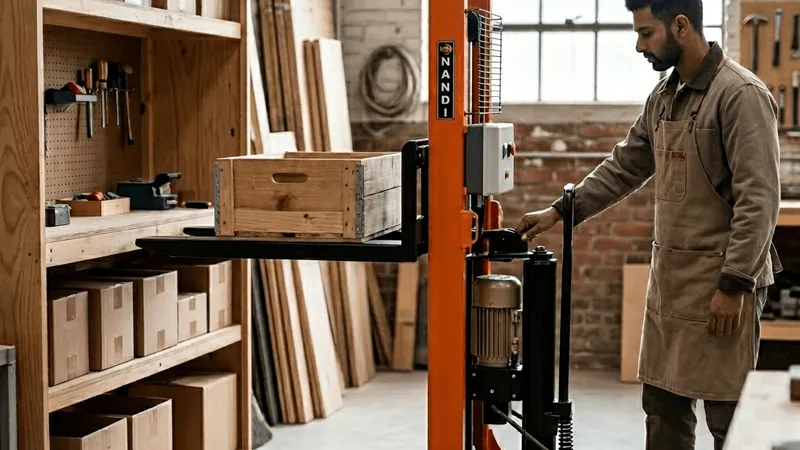
- Semi-electric AC stackers. An AC stacker adds lift chains (check elongation every six months, replace at around 2–3% stretch), polyurethane mast rollers that pick up lint and go hard, hydraulic oil that darkens and thins in 40 °C ambient (change at 12–18 months), and a 2 HP three-phase motor whose contactor and overload relay suffer most from unstable DG supply during power cuts. Proximity sensors drift out of position when the mast is knocked.
- Battery-operated stackers. On a battery stacker the 24V/345Ah battery is the largest single cost on the machine and the one most often destroyed by neglect: low electrolyte in summer, corroded terminals in the monsoon, and deep discharging on a second shift with no opportunity charge. Expect 4–5 years with weekly topping-up and correct charging; 2–3 without. The charger and the Curtis controller themselves are reliable, but loose connections behind them cook contactors and throw fault codes that look like controller failure.
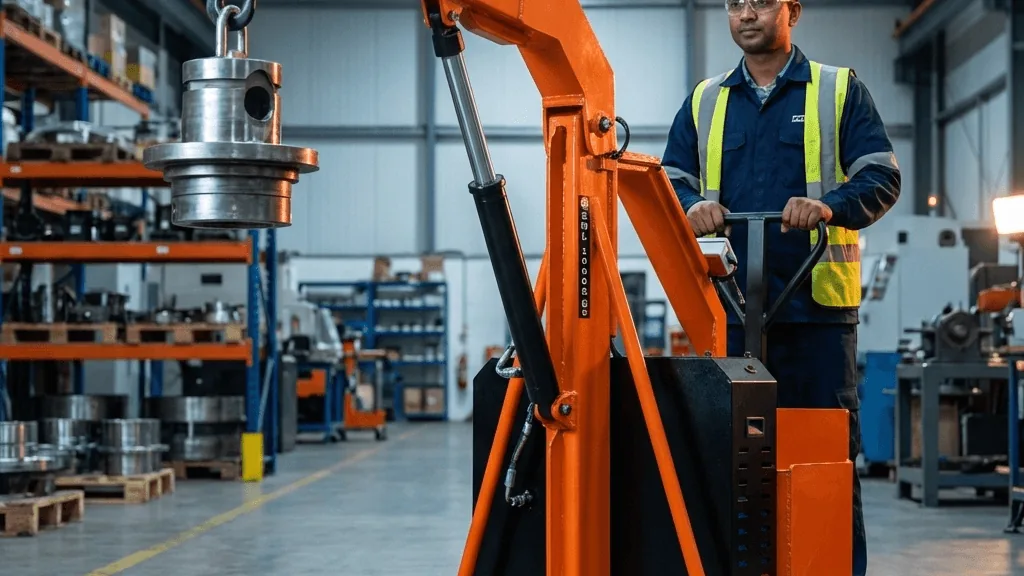
- Hydraulic jib cranes. A manual hydraulic jib crane is close to maintenance-free, which is why its two real wear points get ignored: the cylinder seals around the EN8 hard-chromed piston (look for weeping and slow boom creep with a load hanging) and the brass bushes at the fulcrum points, which need greasing and eventually replacing before the pins start to oval the holes.
What a stopped shift actually costs
Before you price any contract, put a rupee figure on one stopped hour in the area the machine serves. Take an illustrative example: a two-shift auto-component plant near Coimbatore with one AC stacker feeding a press line. The stacker’s seal fails on a Tuesday afternoon.
- Direct stoppage. Six operators and a line supervisor idle for four hours until a spare machine is borrowed from stores: roughly ₹9,000 in wages and ₹60,000 in lost contribution at ₹15,000 an hour.
- Recovery. A Saturday overtime shift to catch up the schedule: ₹35,000.
- The repair itself. Emergency call-out, a seal kit couriered from the nearest stockist, and a second visit because the first fitter misdiagnosed the pump: ₹12,000.
- Collateral damage. Contaminated oil run for three months through a leaking system has scored the pump. Add ₹25,000.
That one event is in the region of ₹1.4 lakh, of which the actual seal kit was under ₹3,000. The figures are illustrative, but the shape is not: the part is never the cost. The timing and the collateral damage are.
A maintenance contract is not a cheaper way to buy repairs. It is a way to choose when the repair happens, and to make sure the right part is already on the shelf when it does.
Planned versus reactive: the economics side by side
| Dimension | Run to failure | Preventive AMC |
|---|---|---|
| Fixed fee (3 years) | Nil | ₹3.6 lakh (illustrative ₹24,000 per machine per year) |
| Unplanned failures | 7–8 events | 2–3 events, shorter because spares are stocked |
| Parts and call-outs | ₹2.5–3.0 lakh, at emergency pricing | Consumables included; major spares at list price |
| Downtime | 30–40 hours, usually at month-end | 5–8 hours, planned visits on off-shift |
| Collateral damage | Common: contaminated oil, scored pumps, sulphated batteries | Rare: wear items replaced before they take anything with them |
| Cash profile | Lumpy and unbudgeted | Even, and known at budget time |
| Machine life | 8–10 years | 15 years is realistic for well-kept Nandi equipment |
Multiply the avoided downtime by your own stopped-hour figure and the comparison usually settles itself. Where it does not, the honest conclusion is that you should not sign, and we say so below.
What a good AMC should contain
Nandi’s service plans are written around duty cycle rather than a calendar copied from a temperate-climate manual. Whoever you contract with, insist that the document commits to the following in writing.
- Visit frequency tied to duty. Quarterly for two-shift powered equipment; half-yearly for single-shift manual equipment. Each visit should leave a signed checklist showing chain elongation, oil condition, battery specific gravity, wheel wear and a functional test of overload relay and emergency stop.
- Consumables included. Hydraulic oil, grease, seal kits and wheel bearings should be inside the fee. If they are billed as used, the fee is a discount scheme, not a contract.
- Breakdown response in hours, not “promptly”. Within Coimbatore and Tiruppur we work to a same-day response; across Tamil Nadu and Kerala, 24 to 48 hours is realistic and should be written down.
- Spares stocking. Who holds what. A critical-spares kit on your own shelf (seal kit, a set of wheels, a contactor, a proximity sensor) costs a few thousand rupees and removes the commonest cause of a multi-day stoppage.
- Annual load test and recertification to IS requirements, with the certificate handed over.
- Operator refresher. Half a day a year. Most seal failures on pallet trucks and most battery deaths on stackers trace back to operating habits, not to the machine.
When an AMC is not worth it
We would rather sell you a machine you keep for fifteen years than a contract you do not need. Do not sign if:
- The equipment is manual and lightly used. A pallet truck or jib crane moving a dozen loads a day needs a grease gun, a monthly look at the wheels and a seal kit every few years. Buy the seal kit, keep it in the stores, and call us when you need it.
- You have a competent in-house fitter with time. Many textile mills and paper units already run a maintenance department. Give them our checklist, a spares list and one day of training at installation, and pay only for the annual load test and the occasional specialist visit.
- The machine is near end of life. A twelve-year-old stacker with a tired mast and a battery on its second replacement is not a candidate for a comprehensive contract. Run it to failure on a labour-only basis and budget for its replacement.
- You have redundancy. If a second machine can cover for a week without production loss, your stopped-hour cost is low and the arithmetic in the table above collapses.
Questions to ask before signing
- What is the committed response time in hours, and what happens if it is missed?
- Which consumables and spares are inside the fee, and which are explicitly excluded (batteries, tyres, misuse damage)?
- Which critical spares are held in stock, where, and what is the lead time for the rest?
- Is the visit schedule based on my shifts and environment, or a standard calendar?
- What documentation is handed over after each visit, and does it include an IS load-test certificate?
- Is a standby unit available if a repair runs beyond two days?
- Does the fee include an operator refresher, and who trains new operators mid-year?
- Can the contract be labour-only for older machines and comprehensive for newer ones in the same fleet?
If the answers are clear and written down, the contract is worth pricing against your stopped-hour cost. If they are vague, the problem is the contract, not the idea.
Tell us your fleet, your shifts and your floor conditions and we will say plainly which machines justify a contract and which do not.